Wednesday, 29 February 2012

Scary, Vile, But Logical: On Abortion, Infanticide and Medical Ethics

In the year AD 1000, Iceland converted to Christianity. According to Njal's Saga, when the Althing accepted the conversion, Thorgeir proclaimed:
'Our first principle of law is that all Icelanders shall henceforth be Christian. We shall believe in one God -- Father, Son, and Holy Ghost. We shall renounce the worship of idols. We shall no longer expose unwanted children.'
The introduction of Christianity and the end of infanticide went hand-in-hand.

Now, a millennium later, the idea of infanticide sounds like something from ancient history. Well, it did; but no longer. Last week the Journal of Medical Ethics published an article entitled 'After-birth abortion: Why should the baby live?' (by Alberto Giubilini and Francesa Minerva). Whilst the authors would prefer to avoid the term infanticide ('In spite of the oxymoron in the expression, we propose to call this practice ‘after-birth abortion’, rather than ‘infanticide’, to emphasise that the moral status of the individual killed is comparable with that of a fetus ... rather than to that of a child.'), that is essentially what they are advocating.

The Eternal Purpose: The Body, The Head & The Filling

Yesterday I wrote about what the Church is for, and concluded that it's for fulfilling God's Eternal Purpose and bringing glory to Him throughout the eternal ages. Today I want to think a bit that a bit more.

First of all, what's this Eternal Purpose all about anyway? The book of Ephesians teaches us a lot about God's Eternal Purpose. Eph. 3:10-11 tells us that God has an Eternal Purpose centred in Christ and His Church, which involves the Church displaying God's manifest wisdom. Eph. 2:7 teaches us that the Church will display God's grace throughout all eternity, and Eph. 3:21 tells us that the Church, through Christ, is to glorify God throughout eternity. Eph. 1:9-10 teaches us 'that in the dispensation of the fullness of the times He might gather together in one all things in Christ, both which are in heaven and which are on earth—in Him.' Of course, this isn't all that the Bible (or even just Ephesians) teaches us about God's Eternal Purpose, but just a few key verses.

So how can we summarize the Eternal Purpose? (And notice that I say summarize!) Well, in good preacher-style, with 3 main points:

Meanwhile, Elsewhere (29/2/12)

Give Up the Gimmicks, Youth Pastors - Brian Cosby
'With all my heart, I plead with you to not be tempted with "success," professionalism, or the fading fads of our entertainment-driven culture. Rather, pursue Jesus as the all-satisfying Treasure that he is and feed his young sheep with the means God has provided.'

The Kingdom of God in the Middle of Nowhere - Trevin Wax
'But as I listened to the joyful voices of the church members, believers remaining faithful even as their way of life crumbled around them, I came to see the power of God’s kingdom in a unique way. The presence of the Lord seemed palpable in that little village church in the middle of nowhere. Somehow, serving in the place of powerlessness stirred up within me a powerful sense of hope and joy. I then felt sorry for my pastor friend. He was missing out on such a blessing!'

8 Ways to Pray in Preparing to Lead Worship - Matt Boswell
An adaptation of Mike McKinley's '8 Ways to Pray During Sermon Preparation' (see Saturday's Meanwhile, Elsewhere) for worship leaders.

Is "God Inhabits the Praises of His People" Really Biblical? - Zac Hicks
'Ultimately, it comes down to integrity. Will I approach the Scriptures as honestly as possible, and will I model that honesty thoroughly before the people I lead, even when it eliminates what I considered a major tool in my “worship theology shorthand” arsenal? Sometimes (and I am guilty of this, too), we allow a little mis-exegesis to slide because “it’s just too good.” But if we desire to be trustworthy as pastors, teachers, and leaders, we need to try to be as exegetically honest as possible, even as Christ forgives and washes His blood over all our shoddy best efforts.'

Tuesday, 28 February 2012

The End or the Means?

How we think about things or make use of them can vary a lot depending on the perspective we're looking from. It's often strange to see how people use the same things in different cultures for very different purposes. It makes me think of the story of Koto San and the wallpaper that talked. Koto San's grandmother, who had forbidden her granddaughter from reading the Bible, ended up becoming a Christian from having her wallpaper read to her. She couldn't read, so had used to pretty patterned paper she found to paper her walls; but the prettily-patterned paper was actually the Bible. She didn't know what it was supposed to be, and so she used it the wrong way (although, admittedly in that case, with good effect).

We can be the same about the Church. Sometimes we use it the wrong way because we don't really know what it is or what it's for. And, just as in the case of Koto San's grandmother and her use of the Bible, God can, and often does, intervene to bring good results. But, God has revealed in His Word what the Church is and what it's for, and so we shouldn't allow His gracious intervention in our mistakes to serve as an excuse when we don't pay attention to what He has to say.

The big question is whether the Church is a means or an end. Of course it isn't usually put like that, but that's often what it boils down to.

Monday, 27 February 2012

Stone and Woe

Then they took up stones to throw at Him; but Jesus hid Himself and went out of the temple, going through the midst of them, and so passed by. (John 8:59) 
'As man He flees from the stones, but woe to those from whose heart of stone God flees!' - Augustine (In Johan. Tract. xliii. 18)

Saturday, 25 February 2012

Meanwhile, Elsewhere (25/2/12)

Again, some reading from other places to make you think.

'I knew that I should pray, that in fact I must pray, as part of getting ready to teach God’s Word. But I don’t remember getting much advice about how to pray when preparing a message. And while there’s obviously not just one helpful way to do it, here are eight brief prayers that can be used while writing a sermon'

The Vision Without Which People Perish - Jared Wilson
'But what if a leader’s good idea for church growth or success was not the vision Proverbs 29:18 had in mind? What if we aren’t free to insert anything we come up with, no matter how spiritual or “inspired by God”?'

What does it really mean to be a Defender of the Faith? - Josh Cordray
Josh Cordray is a fellow Apostolic blogger. He pastors the Maidstone assembly, and here he shows how apologetics isn't just something for a few Christians with special training, but something all Christians all called to do.

Nostalgia Is the Enemy of Faith: Learn from Your Heroes' Warts - Colin Hansen
'It does not insult our heroes to suspect their imperfection. Rather, we insult their God and cloud our faith with the fog of nostalgia if we ignore their mistakes. We end up the losers, because our own day will never measure up by comparison. But if we remember our heroes for who they were---sinners redeemed by a glorious Christ---we'll learn their lessons and deepen our faith in a God who can powerfully work through us, too, even in this wicked day.'

Who owns marriage?

The 2nd government minister to appear here this week.
I had been hoping to write about the Coalition for Marriage campaign next week, but the top story on the Telegraph's website this morning (well, quarter past midnight - who knows what the top story will be when the sun rises?) has forced my attention in that direction. Lynne Featherstone MP, the Parliamentary Under-Secretary for Equalities (and a Lib-Dem), has issued a strong warning to the churches on their campaigning against homosexual "marriage", writing: 'you will not find us watering down this commitment.' In other words, irrespective of the letters and petitions, irrespective of the voice of the people, the government has no intention of changing its mind on the matter. Although all this is somewhat ironic, as Miss Featherstone claims that marriage is not owned by either the church or the state, but by the people.

Friday, 24 February 2012

What is the Baptism in the Holy Spirit?

Filled to overflowing.
This is a question of fundamental importance. Too often we talk about the Baptism in the Holy Spirit without asking what it actually is. This leads many Christians to the mistaken belief that it is merely an experience to be had. This then leads to the thought that it is something personal for the person receiving it. In order to avoid these mistaken ideas, we need to ask what the Baptism in the Holy Spirit really is.

Christ Himself answered this question before His ascension. He told His disciples ‘you shall be baptized with the Holy Spirit not many days from now … you shall receive power when the Holy Spirit has come upon you; and you shall be witnesses to Me in Jerusalem, and in all Judea and Samaria, and to the end of the earth’ (Acts 1:5, 8). Likewise, He told them to ‘tarry in the city of Jerusalem until you are endued with power from on high’ (Luke 24:49). These verses show us that there is a link between the Baptism and the Holy Spirit, power and witness.

Meanwhile, Elsewhere

Some reading to get you thinking, from other places.

Your Theological System Should Tell You How to Exegete - Kevin DeYoung
DeYoung (with some help form Moises Silva) very succinctly shows why exegesis and systematic theology need to go together, demonstrating why the 'insistence on making the path between exegesis and theology a one way street is untenable and unwise.'

An Open Letter to Praise Bands - James K.A. Smith
'So please receive this little missive in the spirit it is meant: as an encouragement to reflect on the practice of "leading worship." It seems to me that you are often simply co-opted into a practice without being encouraged to reflect on its rationale, its "reason why." In other words, it seems to me that you are often recruited to "lead worship" without much opportunity to pause and reflect on the nature of "worship" and what it would mean to "lead."'

Always Mardi Gras and Never Easter - Russell Moore
'Do many Catholics follow their appetites and “sin that grace may abound,” hoping that confession and the last rites will even it all out before God? Sure. And do many Evangelicals do the same, hoping that a repeated prayer or an altar-call response will deliver them in the Day of Judgment? Yes. Both paths lead to the same place: to hell.'

Atonement – keeping legal and familial together - Glen Scrivener
A good reminder that PSA (penal substitutionary atonement), though of foundational importance, doesn't stand alone. 'The penal self-substitution of Christ (which is very clearly taught in the Scriptures) only makes sense with a strong doctrine of the Trinity and of union with Christ. Only if the Crucified One is God Himself intercepting His own judgement, and only if I am crucified with Him does it hang together.'

Thursday, 23 February 2012

"Illegal and morally wrong", or just the logical outcome of "choice"?

The Secretary of State for Health
I thought the UK was shocked and appalled today. You see, I tend to get my news from one of two sources: either the Daily Telegraph (its free app or website - I don't actually buy a newspaper!) or the BBC. And this morning one story was at the top of both. As a result, I assumed it would be the main story of the day everywhere, but I've just had a look and seen that it doesn't even make the front page of the websites of the Guardian or the Independent, and the BBC has demoted it from the main news to the 'Health' section. Perhaps, as it was a Telegraph investigation, the Guardian and Independent will run it tomorrow. (Or perhaps not - the Times has it already.)

So what was this story to shock and appal the kingdom? The discovery that women have been granted abortions by doctors based on the sex of the baby. (You can read about it here in what's currently the main headline of the Telegraph's website.) There have been resignations, the Health Secretary has called in the police, and the Chief Medical Officer is stepping in too. 

Although many commentators have not been so forthright as Mr Lansley in their condemnations, it can't be denied that the Health Secretary was right: that gender based abortion is 'illegal and morally wrong.'

Wednesday, 22 February 2012

Creed or Chaos


Credo in Deum Patrem omnipotentem, Creatorem caeli et terrae,
et in Iesum Christum, Filium Eius unicum, Dominum nostrum
Last Sunday morning we began our service in Leeds with something that I'd venture to say is a bit unusual in a Pentecostal church. It's not something unusual in itself; in fact, it's something that's done in the majority of churches in the UK every week, but just not in most Pentecostal ones. What was this strange practice? We said the Creed.

Hang on now. Before anyone gets too upset with me for doing something so "unbiblical"/"Anglican" (I'm not sure which is meant as the harsher criticism), let's just clear a few things up.

Firstly, the Apostles' Creed is in no way unbiblical. Rather it's role is to give a succinct summary of what the Bible teaches. And that it does rather well. That means that, far from being an unbiblical statement, the Creed is one of the most biblical things we could possibly recite. In an age when all sorts of "preachers" are commanding their followers to turn to the person beside them and recite all manner of mantras, the Apostles' Creed is one of the most biblical of things that could possibly be recited in church. And, when it comes to 'worship', which is more appropriate, 'I believe in God the Father Almighty...' or some song about a 'sloppy wet kiss'?

Secondly, saying the Creed isn't 'Anglican'. Yes, they recite it in the Church of England, the Church of Ireland, the Church in Wales and the rest of the Anglican Communion, but the Apostles' Creed was around a long time before there was an Anglican Communion. And, it's the shared confession of a lot of Christians beyond the bounds of the Anglican Communion as well. Anglicans actually read the Bible, preach and have communion in their services too, but that doesn't make Bible readings, sermons or the Lord's Supper 'Anglican'!

But, while it might be very biblical in its content and not at all limited to the local Anglican parish, it still has to be admitted that reciting the Creed isn't all that Pentecostal. Yet, maybe that's our problem!

Tuesday, 21 February 2012

On human rights for dolphins?! (Or the ethics of killing)

Don't get me wrong.
 I like dolphins as much as the next man.
Scientists and philosophers have joined together to call for a Declaration of Rights for Cetaceans. The declaration, which they'd like to see enshrined in international law, would put an end to the captivity of whales and dolphins, their use in entertainment, and guarantee their right to life. According to the BBC, those calling for the declaration 'believe dolphins and whales are sufficiently intelligent to justify the same ethical considerations as humans.' Although not human, they are arguing that whales and dolphins are so intelligent that they must be considered 'people' in the philosophical sense.

The quote in the dolphin story which particularly struck me came from 'Ethics expert Prof Tom White, from Loyola Marymount University, Los Angeles' who said, regarding the killing of dolphins: 'A person needs to be an individual. If individuals count, then the deliberate killing of individuals of this sort is ethically the equivalent of deliberately killing a human being.'

So, the ethicists are now telling us that killing a particular type of animal is the moral equivalent to killing a human being. The implication, of course, is that killing dolphins is bad. Now, I'm not arguing for the killing of dolphins (let's just clear that up before I get a reputation as a dolphin-hater), but Professor White's statement quite simply isn't true. Dolphins are not people. There is a very big difference between the killing of a dolphin and the killing of a human being.

How can I be so sure? Because the Bible says so. The book of Genesis makes clear that there is something different about man. Unlike the other creatures (including dolphins), man was made in God's image (Gen. 1:26). In fact, it's this very aspect of human beings that makes it wrong to kill a human being (Gen. 9:6). That's why there's a moral difference between killing a spider or a cow and killing a human being, because humans are made in God's image. Humans aren't animals, because God has made us with that key difference. But that also means that animals aren't people.

However, the thing that really got my attention about Prof. White's statement was that, if such arguments are accepted, then many people would be giving greater rights to dolphins than to a particular group of human beings. How could anyone possibly accord human rights to dolphins while denying human rights to unborn children?

Perhaps all the scientists and philosophers pushing for cetacean rights are also personally opposed to abortion, but even so, if society were to accept their case, we would end up with a society which is opposed to killing dolphins because of their personhood, yet in favour of aborting people. How could that possibly make sense? How could it be so morally abhorrent to kill a dolphin, but morally neutral to abort an unborn child?

Thursday, 2 February 2012

One Iota (or Relationship vs. Doctrine?)

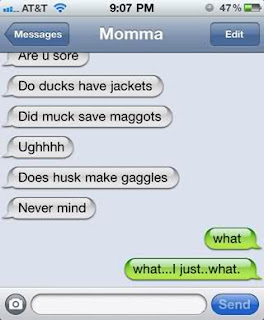
It's a good thing they didn't conduct the Council of
Nicaea by text message. That iota would have
really confused the predictive type.
Theologians can sometimes get a lot of flack, for, while it's generally considered that sound doctrine is a desirable thing, in the eyes of some, theologians just seem to go a bit too far. After all, they ruin all those illustrations people love by pointing out things like the fact that the steam/water/ice analogy teaches Modalism instead of Trinitarianism. Theologians, it would seem, just want to spoil everyone's fun. And in today's social-media-ised world, perhaps the worst way of spoiling people's fun is to hamper relationships; and theologians have a knack for that. After all, we live in an age where "friendships" are made with the click of a button and the great sign of success is to be "liked". When such a light attitude is taken to relationships, it's no wonder that sound theology can be seen by some as an impediment.

Recently a somewhat prominent American pastor wrote, 'The nuance of relationship is sadly lost in the world of those who believe doctrinal accuracy (which they have no corner on) is the pinnacle Christian priority.' (James MacDonald). Relationship, for MacDonald, is more important than doctrinal accuracy. But is he right? More to the point, are we even thinking in the right categories?

The New Testament doesn't ever use the word relationship. That's not to say that the idea of relationship isn't there; it's just that it's not a fundamental category of thought for the NT writers. When the biblical authors do want to explicitly address something akin to our concept of relationship, they do have a word to use, but a very different word: koinonia. We translate this word in different ways in English; perhaps the most common today is the word fellowship. Immediately we can see that this word has something to do with relationships, but yet it also has something unique. It's a distinctly Christian word. I don't have fellowship with the hairdresser, the bank clerk, or even with unbelieving friends; fellowship is something we have with God Himself, and with other Christians.